
Authors
Ganghui Lin, Jon Peha, Marvin Sirbu, and Alex Hills (Carnegie Mellon University)
Abstract
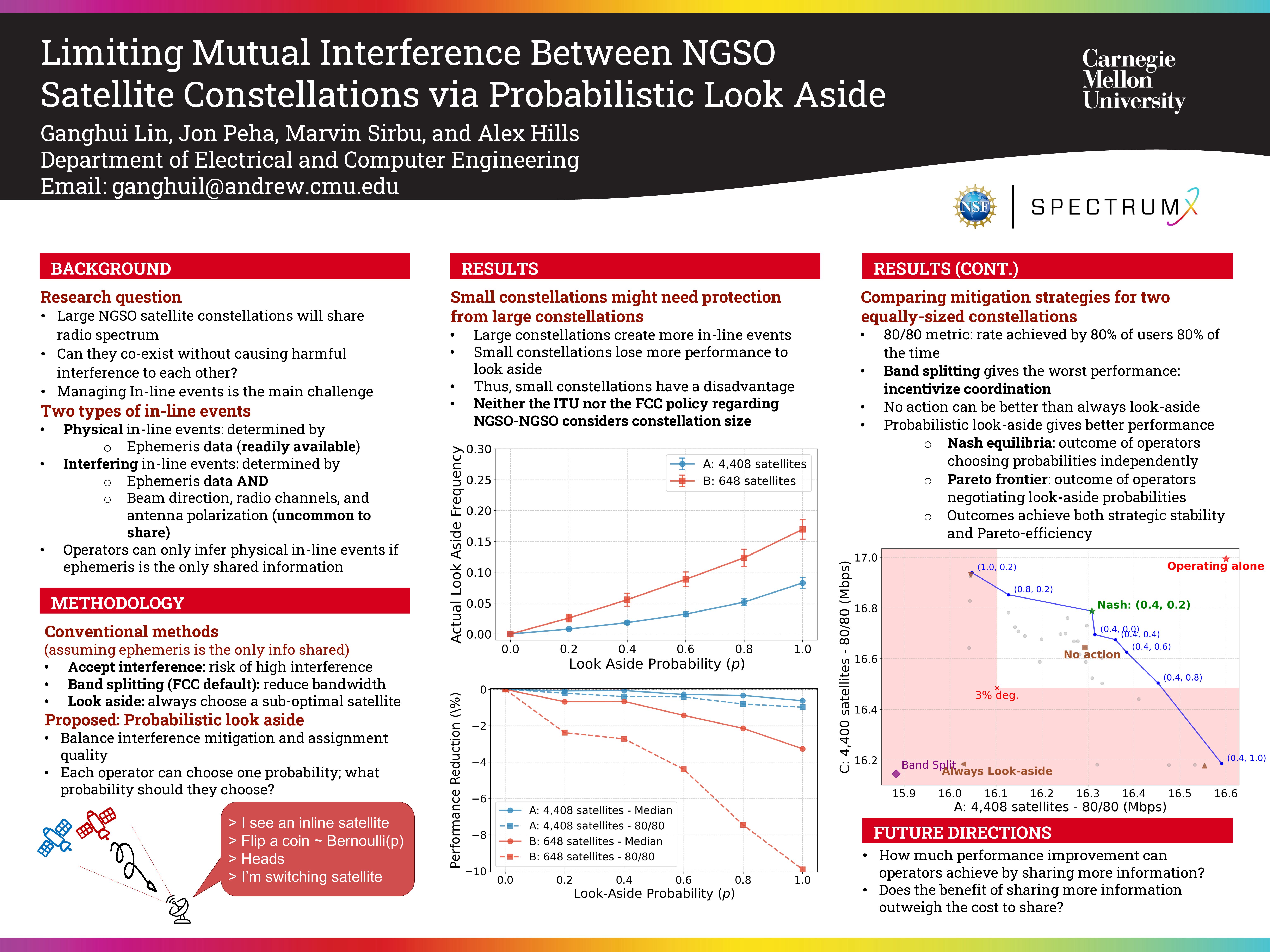
Multiple non-geostationary orbit (NGSO) satellite constellations will share spectrum in the same frequency bands, creating potential for harmful interference when satellites transmit simultaneously on the same frequencies. As mega-constellations with thousands of satellites are being planned and deployed, effective spectrum sharing mechanisms become critical for maintaining service quality. This poster addresses the critical problem of inter-constellation interference management in shared spectrum environments. We propose probabilistic look-aside, a mitigation strategy that enables multiple NGSO constellations to coexist without requiring real-time information sharing beyond the ephemeris data. Through simulation-based analysis over the contiguous US, we evaluate the impact of inter-constellation interference and the effectiveness of different mitigation strategies in two scenarios where constellations share spectrum: 1) one large and one small constellation, and 2) two large constellations. Our results show that passively accepting interference can severely degrade throughput, while always adopting look-aside can perform even worse than taking no action in Scenario 2. The Federal Communications Commission (FCC) default band-splitting approach performs worse than both. In contrast, probabilistic look-aside significantly outperforms no action, always look-aside, and band splitting, providing a practical, low-overhead mechanism for efficient spectrum sharing across multiple NGSO systems.