
Authors
Sarah Tanveer (University of Wisconsin-Madison), Olivia D’Souza (University of Wisconsin-Madison), Vartika Shekhar (University of Wisconsin-Madison), Daniel Sheen (MIT Haystack), Suman Banerjee (University of Wisconsin-Madison), Samuel The (MIT Haystack), Frank Lind (MIT Haystack), Mary Knapp (MIT Haystack), and Ali Abedi (University of Wisconsin-Madison).
Abstract
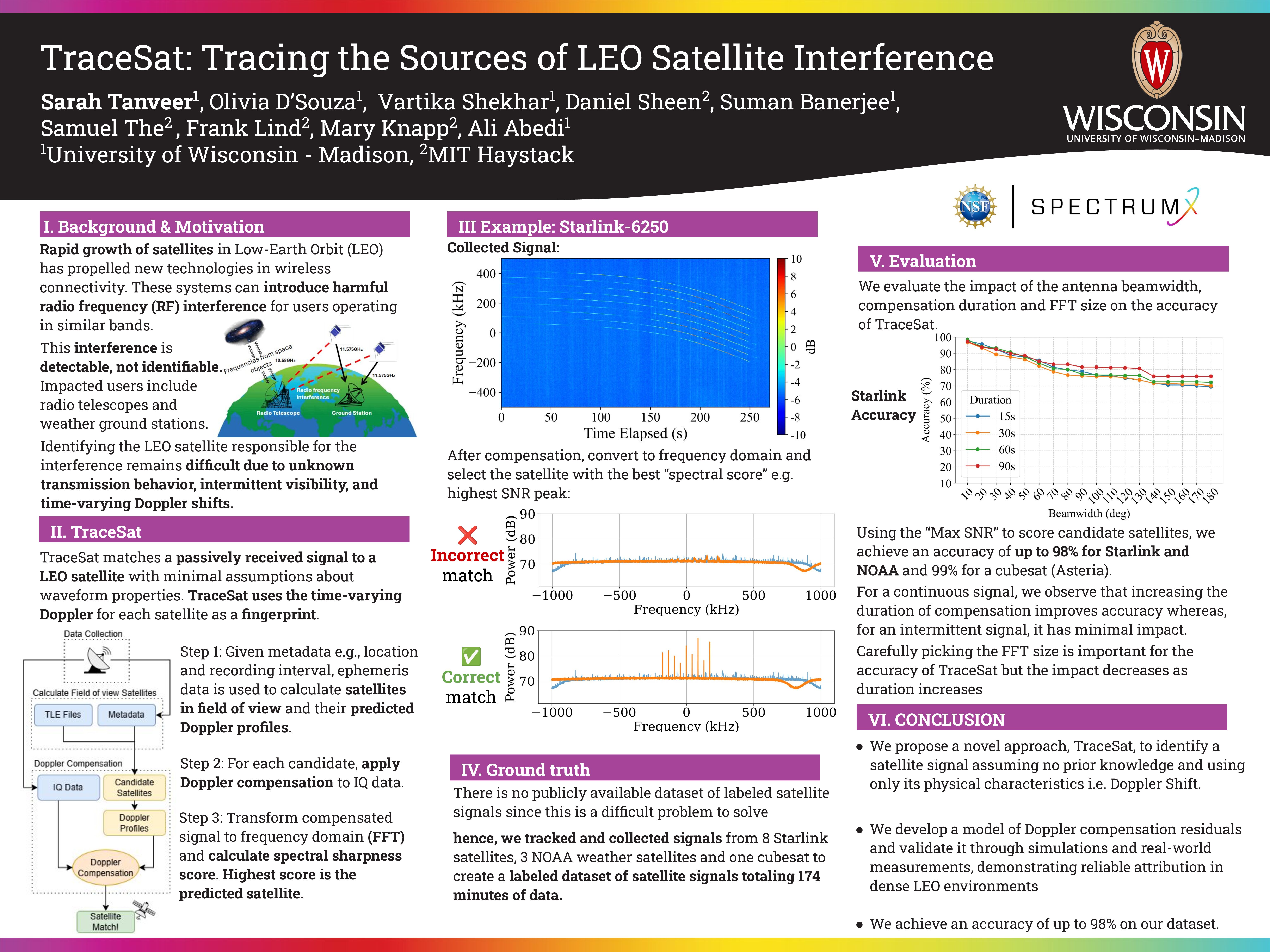
The rapid growth of LEO satellite constellations is transforming global connectivity while also increasing radio-frequency (RF) interference for sensitive spectrum users, such as radio astronomy. While interference events can often be detected, identifying which satellite transmitted the signal remains difficult due to unknown transmission behavior, intermittent visibility, and time-varying Doppler shifts. We present TraceSat, a system for attributing interference to LEO satellites without any knowledge of signal structure. TraceSat enumerates satellites visible during an event, compensates each candidate Doppler profile directly in the received IQ data, and ranks candidates by post-compensation spectral concentration, enabling identification without assuming the signal waveform or transmit frequency. We validate TraceSat through a combination of orbit-based simulations and real-world measurements collected with a radio telescope and a low-cost monitoring platform. Under realistic conditions, TraceSat achieves up to 98% accuracy for the Starlink constellation.